
A growing political storm is sweeping through Akwa Ibom State, raising serious national concerns over unity, credibility, and strategy within the support base of President Bola Ahmed Tinubu, following the controversial emergence of a parallel campaign platform in the state.
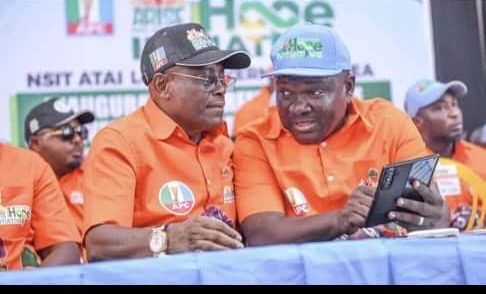
Despite the existence of the nationally recognized Renewed Hope Ambassadors with an officially appointed State Coordinator in Akwa Ibom State, there is a sudden rise of another group with the name: Arise and Renewed Hope Initiative, a development that has ignited a fierce debate that is now reverberating beyond the state.
At the core of the controversy lies a pressing and unavoidable question: Why establish a new political campaign structure when a nationwide machinery, already operational with leadership in place is being sidelined?
In Abuja, the issue took a dramatic turn when the Abuja Coordinator, Prince Godswill Monday Etian, during his interaction with our reporter in Abuja shortly after the Abuja inauguration, openly cast doubt on the effectiveness of the President’s official campaign platform in Akwa Ibom State.
“There is no way the President’s campaign can be effectively driven in Akwa Ibom State, using the Renewed Hope Ambassadors,” he declared.
That statement has since sent shockwaves through political circles.
For many observers, it amounts to a stunning admission that the President’s own campaign structure is either weak, ineffective, or disconnected from the political realities of the state.
The coordinator went further, citing the absence of visible federal government projects as a major setback to mobilizing support for President Bola Tinubu’s re-election in 2027.
“There are no tangible federal projects on ground to campaign with. The people are already dissatisfied, and relying on that structure could lead to rejection,” he added.
This revelation has now placed the Tinubu’s administration under intense scrutiny.
How does a state that is said to be aligning with the center struggle to point to federal impact?
Why is the President’s federal campaign message being repackaged at the state level to gain acceptance?
Attention has also turned sharply to Akwa Ibom State Governor, Pastor Umo Eno, whose backing of the Arise and Renewed Hope Initiative is being interpreted in some quarters as a strategic shift or a political workaround.
The move raises uncomfortable questions about trust, coordination, and transparency.
Why bypass an established national campaign platform for a newly created state-driven structure?
Is this an adaptive strategy or a tacit admission that the existing framework cannot deliver results?
Supporters of the new initiative insist that it aligns with the Governor’s ARISE Agenda and enjoys stronger grassroots resonance. They also point to expectations surrounding federal-backed projects, particularly the long-anticipated Ibom Deep Sea Port, as part of the broader political calculus.
“With the Governor’s alignment to the center and the President’s assurances, projects like the Ibom Deep Sea Port will be realized,” the coordinator said.
But across political and civil spaces, the response has been skeptical.
Many argue that future promises cannot substitute for present realities, especially in a state where voters are increasingly demanding visible outcomes.
In what many now describe as the most revealing moment of the controversy, the coordinator made a blunt declaration:
“As far as Akwa Ibom State is concerned, the Renewed Hope Ambassadors are not active. What is operational is the Arise and Renewed Hope Initiative.”
The implication is profound!
A national campaign structure exists but is reportedly inactive.
A state-backed structure has emerged but raises legitimacy concerns.
Together, they paint a picture of fragmentation at a critical political moment.
Across the country, analysts are now watching closely, warning that the Akwa Ibom situation could reflect deeper cracks within the broader campaign architecture.
For many Nigerians, the questions are becoming sharper and more urgent:
Is this a case of strategic political adaptation or evidence of a campaign struggling to find its footing?
Who bears responsibility for the apparent disconnect, the presidency, the state government, or both?
As the debate intensifies, one reality stands clear: The emergence of the Arise and Renewed Hope Initiative has done more than introduce a new campaign platform, it has exposed fault lines that demand answers at the highest levels of leadership.