
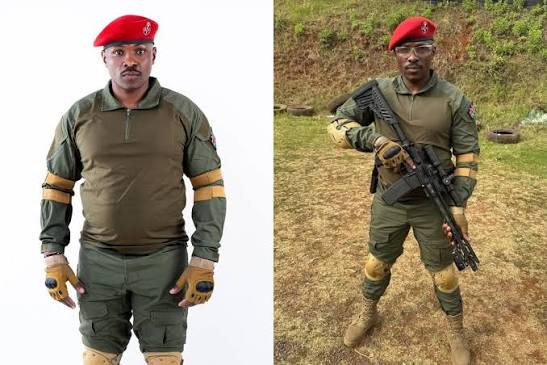
A short but fiery video of former Kenya Defence Forces (KDF) soldier Patrick Osoi has been circulating widely on social media since 10 October 2026. In the clip, Osoi, dressed in a green military-style uniform and red beret, speaks from a podium marked “Lions Movement” and directly addresses Nigerian billionaire Aliko Dangote.
His message is blunt:
“I want to tell Aliko Dangote, please don’t rush to start the refinery because, when I’m sworn in as President of Kenya next year, you will be heading back to Nigeria. We Kenyans have business people who can start the refinery.”
Osoi is presenting himself as a future presidential candidate in Kenya’s 2027 elections. His statement frames the massive oil refinery project as something that should be left to local Kenyan investors rather than foreign capital.
The project in question is the proposed Dangote East Africa Refinery in Lamu, on Kenya’s northern coast. In late September 2026, Aliko Dangote and Kenyan President William Ruto broke ground on the $16 billion facility. Once completed, around 2030, it is expected to process up to 700,000 barrels of crude oil per day, making it one of the largest industrial projects in East Africa’s history.
Dangote has offered regional governments a combined 30% stake in the refinery. The project aims to reduce East Africa’s heavy reliance on imported refined fuel and is being positioned as a major boost to regional energy security and industrialisation.
The video has drawn mixed reactions. Some viewers see Osoi’s remarks as bold nationalist talk, while others have mocked the statement as unrealistic and poorly timed, given the scale of the investment and the fact that construction has reportedly already begun. Replies on X have described the comments as “stupidity that should be studied” and questioned why Kenyan business people had not already built such a refinery in the decades since independence.
The clip was first widely shared by Kenyan account @a_m_media_ke and has since been reposted across multiple African accounts, amplifying the conversation beyond Kenya.