

The All Progressives Congress (APC) in Plateau State has been hit by a wave of intense protests, internal rebellion, and public demonstrations following the fallout of its recently concluded primary elections. From aggrieved high-profile aspirants to grassroots women’s groups and youth stakeholders, multiple factions are accusing party leadership of subverting internal democracy, violating the Electoral Act, and attempting to hijack the mandates of duly elected candidates ahead of the 2027 general elections.
A breakdown of the unfolding crisis across various constituencies highlights deep fractures within the state’s ruling party structure.
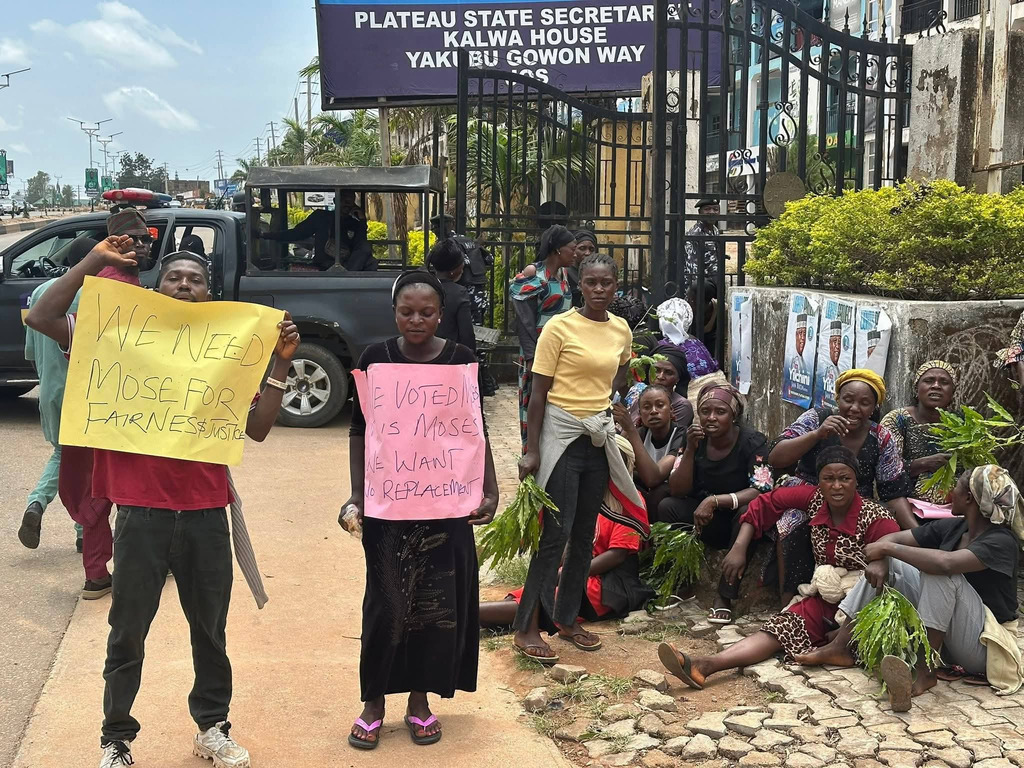
In Bassa Local Government Area, a massive crowd of concerned women and widows took to the streets to demand justice over the APC House of Representatives primaries for the Bassa/Jos North Federal Constituency. Chanting slogans in support of their preferred candidate, the demonstrators called on APC leaders to respect the true outcome of the vote.
According to the protesters, their candidate, Alhaji Abdullahi Yusuf Incham (popularly known as “Oga Perfect”wink, secured a landslide victory by sweeping 15 out of the 16 federal wards in Bassa where voting peacefully took place.
The women sharply criticized the party’s inability to conduct a uniform, transparent process, pointing out that while Bassa voted orderly, elections were allegedly stalled in neighboring Jos North. Despite this, party officials reportedly went ahead to announce a consensus candidate in the absence of the other aspirants. Warning that this move directly violates Nigeria’s Electoral Act, the group appealed to the national leadership to immediately validate Incham’s victory to avoid an existential internal crisis.
Simultaneously, a formidable coalition of top Plateau APC aspirants has formally petitioned the party’s Election Appeal Committee, demanding the total nullification and rescheduling of the primaries.
Addressing a press conference at Kalwa House in Jos, the high-powered group—which includes Senator Diket Plang, Ambassador Chris Giwa, Hon. Gyang Zi, and Senator I.D. Gyang—alleged widespread irregularities, lack of credibility, and severe procedural violations across senatorial, House of Representatives, and House of Assembly contests.
Speaking on behalf of the petitioners, Senator Diket Plang fiercely condemned the exercise, labeling it a “blackmail of democracy.” The group alleged that some results were fabricated and announced without any voting taking place. Furthermore, they claimed that multiple aspirants were subjected to intense pressure to step down without formal agreements, legitimate consensus frameworks, or written documentation.
While reaffirming their ultimate loyalty to the APC, the heavyweights insisted that nullifying the fraudulent exercises is the only way to safeguard the party’s integrity and public confidence moving toward 2027.
In Jos South, the narrative of systemic manipulation continued as concerned APC youths and key stakeholders openly rejected what they characterized as backroom attempts to alter the outcome of the May 20, 2026, House of Assembly primary election.
Spokesperson for the youth alliance, Comrade Andrew Dalyop, issued a stern warning to party administrators during a media briefing in Jos. Dalyop demanded the immediate release of the authentic results, emphasizing that any attempt to substitute the grassroots’ will with handpicked alternatives would backfire. “Every single vote cast during the primary must count,” Dalyop insisted, calling for absolute transparency.
The most volatile reaction occurred in Jos North Local Government Area, where a massive, angry protest paralyzed major parts of the city. The unrest erupted following leaked reports that the APC House of Assembly election committee was actively planning to deny the mandate of Hon. Adamu Aliyu, the reported winner of the Jos North-North Constituency primaries.
Losing patience with the party’s internal mechanisms, furious youths stormed the streets in open rebellion. In a dramatic show of rejection, the demonstrators publicly burned APC flags and the party’s symbolic brooms, chanting aggressively against imposition and political godfatherism.
The unrest rapidly spread to other strategic flashpoints, including a major demonstration staged at the Angwan Rukuba Junction. Traffic was disrupted as passionate loyalists of another aspirant, Harry Ishaya, blocked the area.
The protesters loudly accused party elites of trying to deny the people their rightful mandate, demanding that Ishaya’s votes be recognized and upheld.