

Political tension is rising across the state following the sudden appearance of posters bearing the image of Clement Bamigbola Kolawole as a factional gubernatorial candidate of the Accord Party in several local government areas.
The development has triggered fresh controversy within the Accord structure, casting uncertainty over the political future of Governor Ademola Adeleke ahead of the coming election cycle.
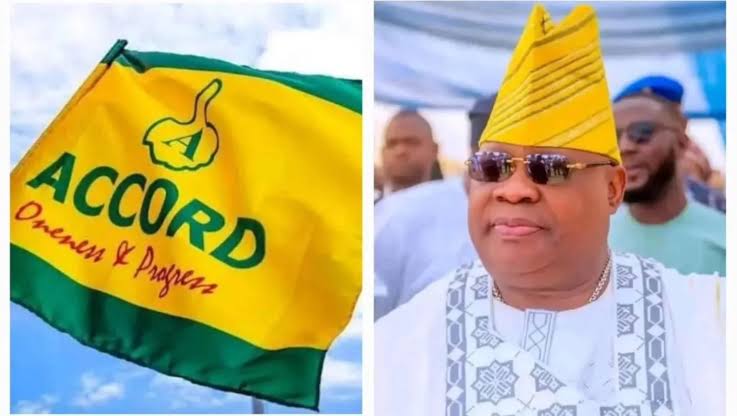
At the center of the crisis is a pending case before the Federal High Court challenging the recognition by INEC of the Maxwell-led faction of the Accord Party, which reportedly produced Adeleke as its gubernatorial flagbearer.
In a dramatic twist, another group of party members has filed a fresh suit at the Federal High Court, Abuja, seeking the cancellation of the alleged banning of Maxwell and Ajaja as party executives. The new case, marked FHC/Abj/CS/351/2026, is expected to further intensify the internal struggle for control of the party.
Political analysts warn that a prolonged legal battle could weaken party cohesion and create uncertainty around candidate legitimacy if not swiftly resolved.
Beyond the courtroom disputes, the Adeleke administration is grappling with additional political headwinds.
Recent allegations concerning workers’ salary irregularities within the state government have generated public debate, though investigations and due legal processes are ongoing. Meanwhile, reports of defections by federal lawmakers from Osun to the All Progressives Congress (APC) have amplified concerns within the governor’s political camp.
Opposition voices argue that the cumulative impact of internal party instability and shifting political alliances could affect voter confidence. Supporters of the governor, however, insist that Adeleke retains significant grassroots appeal and remains a formidable force in Osun politics.
Political observers say the governor’s immediate survival strategy may depend on three critical factors: the outcome of the ongoing court cases, the ability to unify warring factions within the Accord Party, and sustained public confidence in his administration’s performance.
While factional crises are not uncommon in Nigerian politics, history suggests that prolonged internal disputes often reshape electoral landscapes in unpredictable ways.
As legal proceedings continue and political alignments evolve, Osun’s political atmosphere grows increasingly charged. Whether this turbulence signals a temporary storm or a decisive shift in the state’s power dynamics remains to be seen.
For now, one thing is certain: Osun is heading into a high-stakes political season where every court ruling, alliance, and defection could redefine the future of Governor Adeleke and the state’s leadership trajectory.