

In a dramatic escalation of the ongoing conflict, Israeli media is reporting that Ayatollah Alireza Arafi, who was just appointed as Iran’s interim supreme leader, has been killed in a fresh Israeli precision airstrike.
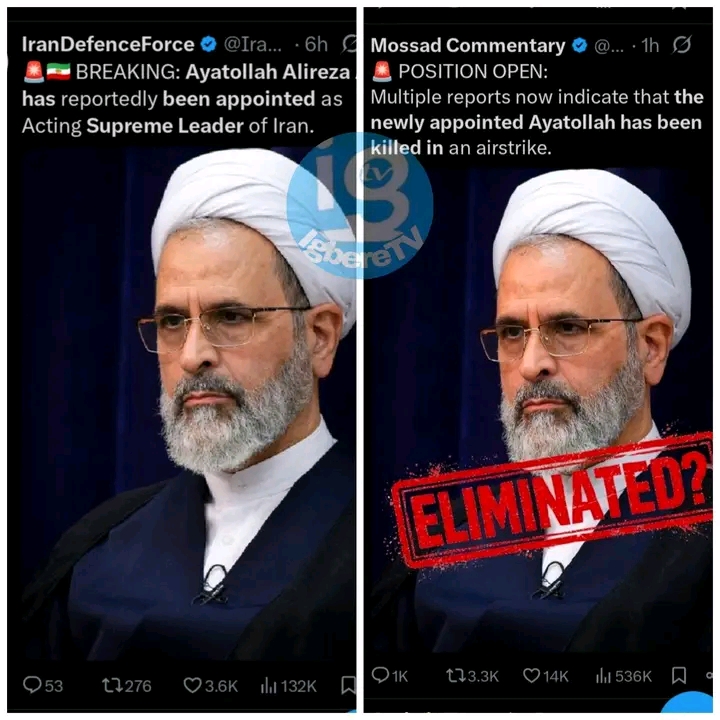
This development comes mere hours after Iranian state media confirmed the death of Supreme Leader Ayatollah Ali Khamenei in joint U.S.-Israeli strikes on Saturday . Ayatollah Arafi, a senior cleric and member of the powerful Guardian Council, was named to a temporary leadership council on Sunday, March 1, to guide the country through the transition .
According to the unconfirmed Israeli media reports, the airstrike that killed Ayatollah Arafi was part of a “fresh wave” of Israeli attacks targeting Iran’s command and control infrastructure. The Israeli military had earlier stated it was dealing a “severe blow” to Iran’s command centers, including those of the Islamic Revolutionary Guard Corps (IRGC) .
If confirmed, the death of Ayatollah Arafi would represent a second decapitating blow to Iran’s leadership in as many days. He was appointed to a three-member interim Leadership Council alongside President Masoud Pezeshkian and Chief Justice Gholamhossein Mohseni Ejei, a body tasked with carrying out the duties of the supreme leader until a permanent successor is elected by the Assembly of Experts .
Who Was Ayatollah Alireza Arafi?
A 67-year-old hardline cleric, Arafi was a longtime confidant of Ayatollah Khamenei and a frontrunner to eventually succeed him . Born in 1959, he was a jurist on the Guardian Council and a member of the Assembly of Experts, the body responsible for appointing Iran’s supreme leader .
He previously served as the head of Al-Mustafa International University, a major Shia missionary and educational institution. During his tenure, he claimed the institute helped convert millions to Shia Islam . He was known for his strong anti-atheist and anti-Western views, and for advocating the use of modern technology, including artificial intelligence, to spread the regime’s ideology . His appointment was seen as an effort to maintain a firm, hardline grip on power during a moment of unprecedented crisis for the Islamic Republic.