

This means that a cumulative sum of N54.7 trillion is planned as new borrowings in 2026, 2027, and 2028.
Areview of the recently approved Medium Term Expenditure Framework (MTEF) of the Nigerian government for the 2026–2028 period by SaharaReporters shows that a total of N54.7 trillion is projected to be borrowed across the three fiscal years.
This means that a cumulative sum of N54.7 trillion is planned as new borrowings in 2026, 2027, and 2028.
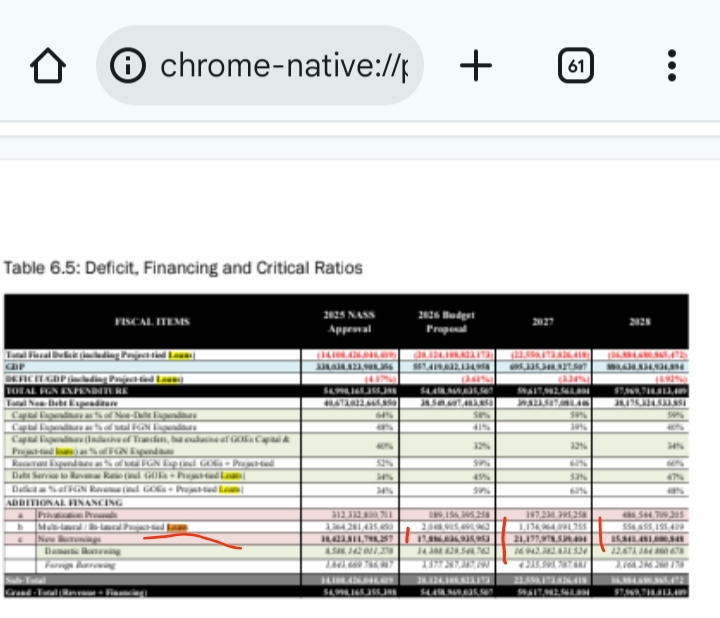
According to the MTEF document, new borrowings for 2026 are estimated at N17.8 trillion. Borrowings for 2027 are projected at N21.1 trillion, while N15.8 trillion is planned for 2028.
A breakdown of the figures shows that in 2026, domestic borrowings are expected to amount to N14.3 trillion, while international borrowings are estimated at N3.5 trillion.
In 2027, domestic borrowings are projected to rise to N16.9 trillion, with international borrowings planned at N4.2 trillion.
Further review indicates that in 2028, domestic borrowings are estimated at N12.6 trillion, while international borrowings are expected to total N3.1 trillion.
A previous review of Debt Management Office (DMO) data by SaharaReporters showed that Nigeria’s public debt rose to N149.3 trillion as of March 31, 2025.
This represents an increase from the N144.6 trillion recorded as of December 2024.
According to the data, domestic debt increased by N4.4 trillion between December 2024 and March 2025, rising from N74.3 trillion in December 2024 to N78.7 trillion as of March 2025.
Meanwhile, external debt grew by N350 billion, increasing from N70.28 trillion in December 2024 to N70.63 trillion as of March 2025.
Nigeria’s debt profile has continued on an upward trajectory. While total public debt stood at N144 trillion in December 2024, it had earlier been recorded at N142 trillion as of September 2024.
During that same period, external debt amounted to N68.8 trillion, while domestic debt stood at N73.4 trillion.
The data also showed that as of September 2024, the federal government alone owed N69.2 trillion in domestic debt, while states and the Federal Capital Territory accounted for N4.2 trillion.
These figures suggest that Nigeria has continued to rely heavily on domestic sources to finance its loan portfolio.
The published total debt profile is also significantly higher than the N134.2 trillion Nigeria owed as of June 2024.
As of June 2024, total external debt stood at N63 trillion, while domestic debt amounted to N71.2 trillion.
Out of this total, the federal government’s domestic debt was N66.9 trillion, while state governments accounted for N4.2 trillion