
A professor of Applied Linguistics at Alex Ekwueme Federal University Ndufu-Alike (AE-FUNAI), Ebonyi State, Nnenna Nwanyioma Nwosu-Nworuh, has developed a computer keyboard designed to support the digital writing of Igbo, Hausa and Yoruba.
The keyboard, known as Linguascript, was unveiled on Thursday, September 3, 2026, during the university’s 10th Inaugural Lecture at the Senate Chamber.
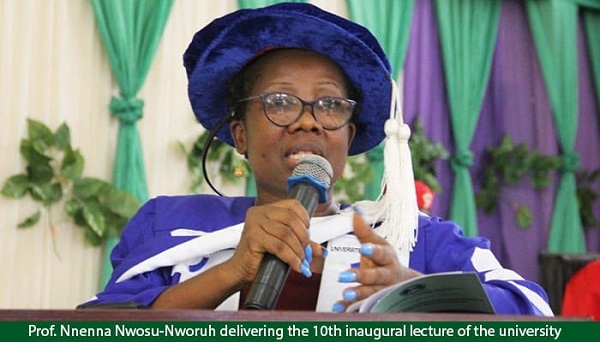
Prof Nwosu-Nworuh, who delivered the lecture titled “Multilingualism and Functional Literacy: Hard, Soft or Blended Skills?”, said the innovation was developed to address what she described as the poor representation of Nigerian languages in digital technology.
She said the absence of Nigerian language features on conventional computer keyboards had created a gap in the teaching, writing and everyday use of indigenous languages.
“No African and Nigerian language features on a computer keyboard. Hence, this is my research innovation,” she said.
The professor said the project took four years of research and development to produce the prototype, followed by another eight years to develop the plug-and-play version.
She called for partnerships with computer manufacturers to produce the keyboard commercially and make it available in schools and the wider market.
Prof Nwosu-Nworuh specifically urged the Federal and state governments to engage manufacturers, including HP, Huawei, Acer and Zinox, to consider producing computers fitted with the Linguascript keyboard.
According to her, wider access to the technology could encourage teachers and students to use digital platforms to learn and write indigenous languages.
She said the project could also support efforts to address the declining use of Nigerian languages, particularly among younger people.
The professor, however, identified funding as a major challenge, saying she had largely financed the research and production herself.
“Of course, there are challenges. I have been funding both the research and the production. Apart from the N500,000 awarded to me as the third-position winner in 2018, I have received no further incentive or funds towards the actualisation of this project,” she said
She urged governments and educational institutions to strengthen language programmes, introduce proficiency-based curricula and provide greater opportunities for language immersion.
Nwosu-Nworuh also called for greater collaboration between Nigerian universities and French organisations to give students practical language experience and improve their career opportunities.
She said language loss was not limited to Igbo, noting that the increasing preference for English in children’s upbringing and education could leave many young Nigerians unable to speak their indigenous languages fluently.
The professor also urged parents, teachers and counsellors to identify children’s interests and abilities early and guide them towards areas where they could perform better.
Earlier, the Vice-Chancellor of AE-FUNAI, Prof. Daniel Nwachukwu, said the university’s responsibility went beyond awarding degrees, stressing the need to produce graduates capable of applying knowledge to real-life problems.
He said, “Literacy without application is empty, and multilingualism without purpose is noise.”
Nwachukwu said the university remained committed to an education system that combines scholarship with practical relevance and service to society.